dinsdag 1 april 2014

A philosophic vacation tour.

Introduction. 

This is a rather philosophical posting about past, present and future of personal transportation, fitness, health and road rage. These are the thoughts that cross my mind when I'm pedaling away vast distances through time and space. The space that is the anchor of this posting is the L770 road in Germany. It is a very special road....


Dream Ride

Only rarely did I ride a nicer section then on the L770 road, roughly between the German towns Petershagen and Bramsche in Lower Saxony and North Rhine-Westphalia. Such a road is ideal for long-distance travelers by velomobile. Every main road should have such wide shoulders for long distance/high speed HPV'ers! 
Excellent shoulder for HPV use.


43km/h average for 50km@177Watts. Link to a bigger picture on Dropbox
Yes, it's alongside cars, but the shoulder from the L770 is wide and just as smooth as the rest of the road, without the debris or discontinuity that for instance the ROAM2011 riders experienced in the USA. I wasn't riding for speed on the L770 actually, which can be seen from the "modest" 177Watts average power. It was part of a 650km long weekend round trip Groningen (NL)- Hildesheim (DE) ride, so I was riding my long distance pace. 

The stage-coach era


If navigation and roads for velomobiles were always this good, travelling by velomobile would certainly catch on more widely. I'm dreaming of the times like of the stage coaches (http://en.wikipedia.org/wiki/Stagecoach), when you would travel all around Europe and spend the night in hostels where you could have a warm bed, dinner and breakfast. My mode of travelling today is very similar to that: I travel from 150 up to 300km a day with my Mango velomobile, check in at a youth hostel, B&B or Warmshowers and have dinner somewhere in town. Next morning breakfast either at the hostel or at one of the bakeries that have an excellent service. If only my navigation could be easier with all roads complemented with a wide shoulder like I had on the L770 road, my daily travelling distance could easily jump to 400km. 
But to be truthful: my average for the full day was not 42,7km/h. http://ridewithgps.com/trips/2414133 And that is not because I got tired or significantly lowered my pace. It was because the other 160km of this day, my cycle navigation took me on smaller roads with intersections every kilometer, gravel roads, the odd sand road, non-existing roads and dead ends.... In the end my average dropped to 30,9km/h which is of course quick for a bicycle, but still..... not nearly as quick as could be and without any more effort.
Nice, but not so good for travelling long distance.
Stranded in loose sand, had to push for a while.
Alternative: go back and take a long detour with no guarantee for  a better result


How will we transport ourselves safe, comfortable and swift without getting.... you know, fat and angry.


But aren't roads for cars (sic). That is of course only for as long as it makes sense (just like the stage coach era ended when trains took over their role). Later the car made personal transport possible, but at a high cost both in traffic incidents and energy waste. Nowadays it becomes ever more clear that personal transport should not take up as much energy, space, public resources and cause so much pollution like the contemporary car or even it's successor, the hybrids and e-cars. Truly efficient bicycles, like velomobiles, are perfectly suited for personal transportation. After all, isn't it obvious that physical activity is just what we need in an age of stress and obesity? The car hasn't lived up to it's reputation of freedom for a long time. Only in car commercials will you see slowly winding coastal roads without any other cars in sight. The bicycle is much safer as well, despite that some people I talk to when I'm on the road like to point out that "they are clearly not safe". In fact the velomobile has an excellent crash protection with it's body of glass/carbon/kevlar. The main reason it's less safe than a car is... the car. The protection level for the people INSIDE the car is excellent, but as for the other road users? Let's face it, the safety of cyclists is very much dependent on the mood swings of drivers. I believe that it's no coincidence that the nice experience I had on the L770 happened on a bright Sunday. During my daily commutes to work, especially when the weather is bad, the temper of most people can be very bad and road rage lurks just around the corner. Of course cyclists are also prone to mood swings. The difference is that they do not present much danger to other road users.

dinsdag 24 december 2013

Been a while....

Actually I wasn't planning of doing two blogs anymore. One in English and one in my native tongue Dutch is a bit much. But since I sometimes do a small post in English on Facebook that gets out of hand and with a bit of work becomes long enough for a blog post, I guess I might as well post it here. 
So here goes....

Two of my three Mangos are riding again. The latest in my stable is called TransforMango. It's a crashed Mango, a total write-off that was rebuilt from scratch with some large-scale tweaks to the body, steering, frame and seat by Delta Hotel (his username on Velomobilforum). It interested me to see what these changes meant and since Delta Hotel moved on to another project, I bought it. I made my own tweaks to it: light weight wheels with wide rims and bladed spokes, Shredda tires, rear axle with ceramic bearings, a customised 10-speed lever shifter from Microshift (on the vertical column, so leaving the steer free for my hands and preventing unwanted steering input), 11-34 cassette (34cogs is definitely the largest that still fits), 150mm cranks, Gingko 14teeth chain idler, custom placement of this idler, KMC X10SL light weight chain. I did not want to wait for an ordered adapter middle chain wheel (Alize K from TA Specialite) to fit three chain rings to a powermeter from power2max. So for now I will go with the two chainrings that were there when I bought it. 
Because both have powermeters, I will be able to compare my trusty Twango with TransforMango.
I have planned some more major changes after I made a "zero" measurement. Because of these ongoing changes, the idea came to me to call it "TransforMango". A Mango to test new ideas...


I rode it home today in Beaufort 6 to 7 and was pleasantly surprised that it handled so good. Gusts were not a major problem. I'm not sure yet why. It may have to do with the lowered body and that my body weight is shifted more to the rear. It felt quick, but with a tail wind of this magnitude it's not surprising to fly home. So I went around, into the wind and could still keep a nice speed. And that was without the aero tweaks that I use on Twango. I'll have to wait until the powermeter is built in before I can say for sure which of my Mangos' is the fastest.

Despite a slow start of the season because of a persistent problem with my achilles, everything has turned around. I have been riding close to 11.000km/6800miles and I'm even racing again.

I feel like next year is going to be a good year! I wish my readers all the best for next year and for now, a very pleasant Christmas and turn of the year.

zondag 19 augustus 2012

EuroTour2013: Testing the Dutch tracks

When I write this, it is Sunday and I am in Arcen, Limburg at the Reception (good wifi-signal) of campsite "Klein Vink". On Thursday I started my trip with a fully loaded Mango with the idea to check the tracks I had mapped out in ridewithgps.com for the EuroTour2013. As usual when I do not have the discipling force of a group ride, I started late, way too late. It was not until 11.30AM before I set out to my destination: campsite de Paasheuvel, but since I skipped the velomobilebuilders in Dronten I could win some time. The track that I mapped looked like this: http://ridewithgps.com/routes/1566205 and I stayed pretty close to it: http://connect.garmin.com/activity/212372761
Not only the tracks were to be tested, but also the campsites. The "Paasheuvel" had looked promising on the Internet and it sure has plenty capacity in a nice setting. The requirements to be met are higher than that though: some 100people in tents and a few vehicles and all will need to charge their batteries, GPS, smartphone and whatever. On top of that it would be very nice to have access to wifi, so blogs can be updated, photos uploaded and maybe even a little movie can be put on YouTube. Upon my arrival at 6PM I had an extensive chat about this with the staff. They had several suggestions that I checked out the next morning.

The next morning.... I woke up late and made a long stroll around the campsite to see the possibilities. I saw only one field that was just perfect: the Ligweide behind the pond. Yes, there is even a pond that we can dip in right after pitching the tents (or before). This field has plenty space, the SAG vehicles can also be there and there are power outlets. (Note: we will need the special three pinned converter for campers and caravans). We maybe can "borrow" some electricity from the standard European outlets in the nearby washroom. Wifi is not free and may not be strong enough at the field itself, but it is available. (I did not take the wifi option, because I could not think of much use for it at the time).

As to be expected I got away late again 10:30AM The mapped track: http://ridewithgps.com/routes/1563685  The distance was about the same, but.... today was hot, burning sun all day and I had to climb. "What?", you might say, "you're still in the Netherlands, what climbing of significance can that be?".  It's true that we do not have mountains and most of the Netherlands is flat, but there are some "glacial tills" or "moraines" that were pushed up during several Ice Ages. The first one "de Veluwe" was unavoidable and besides, it is simply nice riding through moors and forests. The second one between Nijmegen and Germany along the river "Waal" (part of the Rhine) we could go around and maybe we will when somebody comes up with a better route. I chose to again take a route that was the nicest in my view along the "Zeven Heuvelen Weg" (seven hills road) and the river Maas. I would have enjoyed it even more when it hadn't been so blazingly hot. I stopped several times for a place in the shade or at an ice cream parlor to give my body time to cool down. I could sometimes feel a heat stroke closing in, but the pauzes, together with a lot of drinking and spraying myself wet with water from the spray bottle prevented that from happening. My average was disgracefully low, but anyway, I simply did not go to Beyss in Straelen at the same day and stopped at te campsite near Arcen (Klein Vink) that I had picked beforehand. So instead of 160km I did around 130km and arrived at about 6PM. This big campsite is quite ok and it has many facilities, like supermarket, restaurant, Spa and swimming inside and outside, (and you can even have a dialysis for your kidney) but it's also quite expensive while the place for tents on a hilltop (a steep challenge) between trees is nice, but has no power. The price for wifi is extraordinary high :-( Signal strength is excellent throughout the site it seems.

After I installed myself, I learned from others campers that the next day would be even hotter, so here I am at 3:15PM, sitting with my laptop below two blowers at the Reception instead of pushing on and landing at a hospital ;-) Next will be a place in the shade at the waterfront and sit this day out. Phew, it's hot!

donderdag 5 juli 2012

MUV, Mango Urban Vehicle

I always used to think of a velomobile mainly suitable for long distance touring and commuting. So when I came to live in a big city, I didn't think I would often take the Mango into the town centre. Meanwhile however, my other bikes do nothing but gather dust. All rides are done by the Mango: short and long.  To show how useful a Mango can be in urban area and city centre, I made a new playlist on my YouTube channel to show that especially an agile and light velomobile like the Mango is very much at home there.

My first problem is: how to film myself while cruising through the city. The solution is obvious, one simply asks a friend to come along and be filmed. The result is below and more of such vids are likely to follow in the "MUV" playlist of the HuneliggersChannel

BTW: the footage is made by my new camera: Vio POV.HD Please set the quality to 1080pHD, but when the video looks choppy on your screen it might be better to choose a lower setting.


dinsdag 3 juli 2012

"Hindsight" addition

I realized that the photos in my previous post were not giving a very good image of what you see in the mirrors on the body and in da Hood. So.....

mirror in da Hood: one can just see
the lantern post but not what is directly behind 

mirror on the normal position, the body:
Watch the lantern post in the mirror. I can see
what is going on straight behind the Mango

At first sight the field of view does not seem to different. In both cases I can conveniently look in the mirror without turning my head. The mirror in da Hood is at a slight disadvantage however, because it's impossible to see what goes on straight behind. More importantly: I have to pinch an eye to see clearly. I have noticed that in low light conditions I CAN see with both eyes open. Could it be that it's something that I can train?

CONCLUSION, after riding with mirrors inside for a week: for me this is only for racing. The disadvantages are too great for everyday use. What disturbs me the most is the fact that my glasses sometimes hit the mirrors. That is distracting and annoying.

maandag 2 juli 2012

"Hindsight"

One of the things that keep coming back in my thoughts is the subject of looking backwards. Even with da Hood on I can still see a lot to the side and back through the side windows, but it is more practical when I can keep my head still and move my eyes to look in a mirror. When I started riding with da Hood, I added a second mirror to the right side of the body. But maybe there are other ways with minimal impact on aerodynamics? As usual such things are most beneficial in racing, so Cycle Vison is a good incentive to do some work in this direction.


In previous posts I already showed the mirrors inside the velomobile hood, thinking that it would only be somewhat practical in racing. It would mean reduced drag, since I could take off the two mirrors on the body of the Mango. Like in the film above is not quite how I rode during the races at Cycle Vision.  I was not quite happy and thought it needed further tweaking. I had to pinch one eye and move my head sideways to see somebody overtaking. What was worse is that I could not move my head freely as I am used to. My glasses could easily get into contact with the mirrors. It was so uncomfortable that it was quickly decided: I took off the right mirror. The track at CV was left corners only so I needed the left mirror the most. In addition (and since I was planning on filming anyway) I placed a bullet camera facing backwards with the screen/recorder unit on the right wheel box. The screen is very small though and the image is not mirrored, so velomobiles seemed to be overtaking on the wrong side. With all the left turns during the three hour race my brain was busy enough already, so it was not very helpful in the end. (though it made very nice shots of the race)


As you can see I also had a camera facing front...
As the mirror can be rotated around on an excentrical ball joint, I could move it outside the side window of da Hood, giving me a better view (and at the same time giving my glasses more clearance). I still had to move my head sideways to have a good look but it was good enough to see when I could cut back to the ideal line in front of a rider I was overtaking. In the "comments" section on YouTube, someone suggested it might be good enough for everyday. Well, not really, but it seemed like a plan worth investigating to me. So after returning from Cycle Vision the glued-on right mount for the mirror was taken off and replaced by a different one. The stem of the mirror was trimmed down even more and with these tweaks I can move the mirror out the window far enough to see behind me without moving my head sideways. I still have to pinch an eye though, but it seems that I might get used to it.

the right mirror gives the best view backwards


mirror partially outside the window

attachment of the mirror to da Hood. Note the
minimalistic  use of material ;-)


With the right mirror being placed to my satisfaction, I will make the same tweaks to the left mirror. It will have to compete though with the rear camera. Really? Yes! While it was very difficult to process all the visual info during the race, riding home in everyday traffic conditions made a much better impression on me. Sure, not having a mirrored image was slightly awkward, but what struck me was that I could see something approaching with ONE glance, instead of looking right AND left into the mirrors. The Vio recording/screen unit does not need much power either. After 7 hours of riding from Lelystad to Groningen, the 4 rechargeable AA batteries were still 40% full. Also here I need to make an adjustment: for the race I had mounted the bullet camera pretty low to give a nice sense of speed to the viewer, but the view towards traffic and the light compensation is much better when the camera is placed higher. I already made a new hole in the top of the Mango body for this, but my first plan to make a stable mount failed. Still some work to be done there.
low mount of the bullet camera, too low...
To my surprise  Cerevellum is also back with it's "Hindsight" rear view cycling computer. I had ordered this device years ago, but the manufacturer could not bring it to the market at the time and I got a full refund. Hopefully they have more more succes this time. It may seem like an expensive mirror, but being able to see what's behind without lumpy mirrors on a velomobile is an attractive prospect to me. For the time I will concentrate on my own system with the Vio unit. Vio has a new HD recorder with greater looking angle than the analog one I have now. If only it would be able to mirror the image it might be perfect for "hindsight" as well as making recordings.

dinsdag 12 juni 2012

Mango racing tweaks, practical for everyday?

It' s not exactly the first time I'm fiddling with my Mango to make it a bit more aerodynamic and stable in the corners so I can be faster in a race. It gets much more interesting when such tweaks can be permanent. If not for going faster than it will make for a safer and less exhausting ride. For that to happen the impact to practical features like maneuverability and serviceability should be very little impacted. That's why I don't do much effort to find ways to extend the tail like for instance the Germans Ludwig and Holger have done in the past for races.  While it is good for aerodynamics and not very complicated to make, it makes the Mango less compact and therefore less practical for everyday.

Aerodynamic tail added to a Mango+ (foto: Theo Zweers)
I (stop! Who: "I".  In fact it was the infamous David Hembrow and Roelf W who initiated this) have tried to use a less inconspicuous way to improve the tail's air resistance with little strips. See: http://youtu.be/OIIGPLlFsHM It looked promising in theory. But then I rode with it and made some comparative rides and concluded that in reality it didn't make significant difference. It seems that the amount of vacuum behind the Mango did not change much.

Anyway, a long tail DOES make sense for races and I might try it myself one day, it's just not handy for everyday.

But like I wrote before there is more to speed than aerodynamics because racetracks and roads alike can have nasty corners that can have a major impact on the overall speed. What usually happens in corners is that, depending on vehicle stability and agility of the rider, one either has to stop pedaling or (Sturmey Archer forbid) even brake. Either way one has to get up to speed after the corner and then the weight of the vehicle works against the rider. My Mango is probably one of the lightest around at 26,5kg but it still is hard work, especially in a long race resulting in many a corner to overcome. Now there are some tricks to get fast through a corner but I don't want you to get too crazy ideas and make loopings in the air (like I have), so I'll discuss the vehicle itself for now.

At some point I got the idea that stability and aerodynamics could be improved in one go. In earlier attempts I had put strips near the front wheel arches like for instance in the photo below, where I put a white strip above the wheel. Other strips were taped on the underside of the body to prevent as much as possible that air gets into the wheelarch.

aero strip taped in the wheel arch

This made not nearly as much aero difference as "da Hood", but to me there was no question after several training rides and races that such strips for the front wheels made me a bit faster. It was almost practical too, but it could get into contact with the tire when the suspension strut of the outer wheel got compressed in a corner, the tire could hit the strip and when the tire wears through that can cause a flat or even a blow out. I had two flats that way in last year's Cycle Vision three hour race. That was a bit depressing, since I was doing rather well. Some people race "all or nothing" and I guess that's the attitude one needs to win now and then, but I prefer to make it to the finish line without troubles. That's how I got champion of the NVHPV summer competition of 2007: I won only one race that year, but I was present at most of the races of the competition, always finished and got me some points.

So how to get the tire away from the strip? The answer lay in the suspension strut. Hold on for the longer explanation: As I was thinking of a way to get more stability it made sense to try and make the track greater, so more distance between the contact patches of the front wheels. Simply extending the tie rods was not going to cut it, because the wheels would get outside the wheel arch and into the airstream. You can say goodbye to aerodynamics when you do that, but... when you put the top of the suspension struts inward (closer to eachother) the wheel will go inside the wheel arch again. In effect this means more negative camber. Now somewhere in the back of my head I knew that too much negative camber means more rolling resistance. So I did some roll-out tests at my regular test-bridge and was relieved to see that I was still rolling about the same distance as before.

I had to drill two holes, 9mm next to the old ones. This does make fitting bigger tires inconvenient, since they will scrape the inside of the wheel arch when cornering sharply. Oh well, I was really getting into the fast Durano 28-406 tires anyway....

to the right of the nut, light coming through the old hole
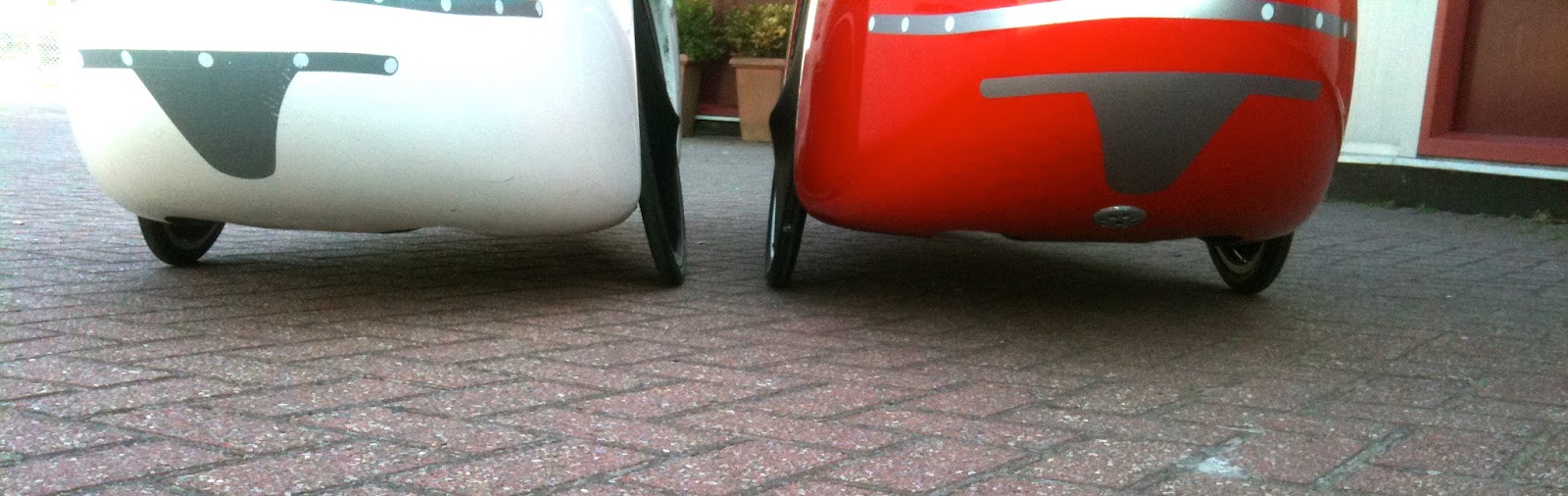
The result of this can be seen below: left is my modded Mango Sport and right is a standard Mango Sport. My wheels are clearly at a greater angle to the vertical and the track is widened by 2,5cm
Hmmm, but wait a minute, looking more closely at the foto, isn't the white Mango lower than the other?

white Mango: more negative camber

The plot thickens now, because I did something else to improve stability: lower the centre of gravity. I lowered the Mango by about 2cm by shortening all the springs in the suspension struts.

white/grey Mango is 2 cm lower

To make things even more complicated and to prove that I am in no way doing a scientific research here, I also gave the wheels a bit more positive caster by shortening the tie rods between the front of the wheel arch and suspension strut. I already found in an earlier temporary modification that this makes the steering a bit heavier and thus less sensitive to undeliberate or unconscious steering input and other influences. In the flat Netherlands I do not feel much diference from more positive caster, but it might be very good in a fast downhill. For an online explanation of camber and caster: http://www.yospeed.com/100304-wheel-alignment-explained-camber-caster-toe.php

So what have I achieved now? Well amongst others the wheel at the top are more inward in the wheel arch and this means that when I put an aerostrip over it, it will not touch the tire easily. I can even make the strip bigger.


This should give me a greater aero advantage than the previous, smaller strips. I can steer sharply (although turning radius has increased a bit) and even under load the tire dos not touch the strip. Ok, so the stiffer shorter suspension also helps there, granted. 

So how practical is my machine now, is it worth it? The future will tell, but one thing is already clear: It won't be fun to get on a sandy trail, since the narrow high pressure tires will sink easily into the sand. The smoother the road the better the comfort is with these tires. Then again, when the changes are a bit less drastic I am sure that 35-406 Kojaks will also fit and that is a pretty standard velomobile tire.
Ohw, I almost forget: stability did indeed get significantly better. All the corners on my commute can be dealt with faster than before and it is easy to control the Mango. I am even thinking of picking up an old habit to try and beat my fastest commuting time. If only the other commuters and schoolkids wouldn't look so angry in my mirror when I swoosh by them..... I meet them everyday, so I'd better stay friends.

Can something be done to get the full range of up to 42-406 tires for the Mango Sport back? Yes there is, but it is not simple, because it means changing the molds of the Mango. These molds are very capital intensive, since it took very long to make them. Changing the wheel arches of the Mango molds to allow for more negative camber will mean a big investment.... For now I will keep on making small adjustments to the wheel alignment to make the most of what we have now.

zaterdag 19 mei 2012

Ride to SPEZI. Day 1: Unprepared rider to the pedals.


Finally the report of my ride to the SPEZI and back. It was quite a task I had attached myself to: 3 days to ride to SPEZI through hilly Sauerland and 3 days to get back along the flat Rhine. During the winter I had almost only been riding to work (2x5km) and my only preparation for longer rides was three rides of about 100km. Feeling that my body needed a tough challenge anyway to get myself somewhat into shape again, I said to myself that it would have to do. Given that there was also going to be a reunion of the ROAM "veterans", there was no question that I would ride ROAMango there. This despite the fact that I had been riding my grey Mango Sport all winter. I had lend ROAMango to my sister for most of the winter and it was still in Twist (near Meppen, Germany). I had been planning to collect it beforeheand, but time was running out and since Twist was on the route, I agreed with my sister that she (in fact it turned out to be my brother-in-law) would pick me up and I would start out in Twisk. This would cut the 1200km ride by 75km, but would mean that before I got to ride, I had to adjust seat and BB bracket position to my size. I also lubed the chain, pumped the tires and the DT Swiss rear shock.

After setting off towards the Youth Hostel in Munster, I had to adjust the BB7 disc brakes several times to get them to brake exactly equal. On flat ground it's not a big problem, but I was going to meet hills later and in a fast downhill you don't want your velo to veer off into one direction or the other.....


destination day1: youth hostel in Munster


Cycling in Germany is completely different from the Netherlands. Munster and Groningen are both cities where many people cycle, but in Munster the facilities are not nearly as good as in my hometown. The cyclepaths are mostly horrible, narrow and in town space is shared with pedestrians. Now really! The discontinuity of cycling routes is very bad for me as a long-distance cyclist. Especially outside the cities I prefer the safety of the segregated cyclepath, but the quality is so variable that many times I feel that I'd better switch to the road. This is often a dodgy maneuver because of all kinds of obstacles between cyclepath and road. I would navigate a lot quicker when, like many German velomobilists, I would default to the road. I really do not feel safe there though.... I mean, there are blind bats in all traffic categories, but the ones in heavy steel cages are definitely the scariest. Despite this, I am experienced enough to deal with that. I just can't help but thinking about the less confident and very young cyclists that are put off by less safe conditions. When that happens ultimately only the sporty riders and thrillseekers remain and cycling for getting around town will suffer.
It's a shame that Germany does not seem to identify cycling as a viable, non-pollutant and healthy way to get around that should be encouraged more by means of safe cycling for everybody, especially since they are doing very well in the field of alternative energy sources: I saw many roofs covered with solar panels and huge windmills were abundant.

I could have done more however to prepare a decent route myself though. I was just going South and checking my Garmin now and then to see if I was going roughly the right way. So with the inevitable detours, it still took more than 200km's to get to Munster.


part of the track, not the shortest route (cough)


Knowing my sorry state of fitness, I had planned to take it easy, but in hindsight my average heartrate was 147bpm. What!? Too high for long distance cycling, so no wonder that after a shower and a good meal at a Greek restaurant I felt very sleepy and I went to sleep early to be fit for the next day when I would meet the first serious hills.

So far to the uneventful first day, things would get more interesting in the following days.....


zondag 8 april 2012

The flip point: extremely narrow tires on velos

Tires have been one of my favorite subjects to investigate from the day I found out that the rolling resistance at moderate velo speeds is almost as high as the aerodynamic drag. Apart from reading a lot about it on the Internet, I have switched tires countless times (I have a closet full with half used tires) and almost every time I ride home I roll down from a small bridge to see how far the tires of choice will roll. This is of course not very scientific, but over the course of the years I have gathered a lot of insight on tires this way.
Rolling resistance is the energy that is lost when the tire deforms in contact with the road and the rubbing of the rubber molecules amongst each other. There are several ways to make these losses smaller. Narrow racing tires typically use the most advanced techniques to lower the rolling resistance (RR) like more and thinner threads to make a thinner and more supple tire possible and better rubber compounds. For wider touring tires, the tire producers tend to give more attention to puncture proofness and durability. I think I can safely say that the HPV scene is slowly changing this, because there are a lot of geeks among them that like to push the tire producers towards Speed.
Especially velos do not really need the low aerodynamic drag of a narrow tire, because they usually are embedded in wheel arches where they are almost completely out of  the airflow anyway. Since a wide tire deforms less than a narrow tire they can have a lower rolling resistance, but only when the rubber compound and the tire casing shows up similar techniques as the narrow racing tire. However, the narrow tire has a last line of defense! It can be pumped up much harder than a wide tire before bursting. A hard tire deforms less in contact with the road, so less RR.

The following question came to my mind: how practical is it to use narrow racing tires on a velo?
To come up with an answer, I have ridden Schwalbe Durano 28-406 on the front wheels all winter long and for a shorter period the most extreme 20" tire on the market: Schwalbe Ultremo 23-406.

Durano: a racy tire but much more durable than it's predecessor the Stelvio (not in produktion anymore). I managed to wreck the sidewall of a Stelvio in one race, but the Duranos' can handle almost anything I throw at them. Almost, for the one thing that took one of the Duranos' out prematurely was heavy braking to the point that I lock up the wheel. The abrasion was too much and the road simply scrubbed right through the canvas, also destroying the tube inside.

destroyed Durano, the canvas scrubbed through

Well, since then I have been braking in  a more sensible manner and didn't have that problem anymore.
As to the riding experience: the Duranos' are fast tires and they give the Mango the smallest possible turning circle, so agility is also better. The feel in corners is very direct, so I know exactly what is going on. Because of the 9,5 bar of pressure I keep in them,  they do not bulge under the heavy load in fast cornering like wide tires do, especially when the pressure is down to a very comfortable level. Especially in roundabouts the velo may become a "Gallopin' Gertie"  with the loaded front tire hopping up and down uncontrollably until you slow down. I like to go fast in corners, so this all is a big plus for me.
Not related to RR, but the light weight does also contribute to the riding experience, since I do relatively much riding in town. A lighter tire accelerates easier, since there is less  rotational weight to bring into movement. Likewise, braking is a bit quicker but as written before, it is wise to not let the wheel lock up completely.
On a sidenote: I have put on lighter wheels with narrower rims to have even less rotational weight. The narrow rim is also better suited to such a narrow tire.
Comfort is of course less than what I was used to, but since the Mango has good shocks it's not much of an issue. I got used to it soon enough, but I do avoid getting next to the road and ride much slower on cobblestones. High pressure in the tires does make the velo noisier as impacts are simply more intense. Despite the high pressure and ensuing small contact patch, there still is a reasonable amount of grip on the road. I was surprised by that, since I had the idea that the high durability (for a narrow racing tire) must have something to do with a hard, slippery compound. Not so: the grip is not much less than that of the wider Kojak.
To make things more interesting, we had snow for a while this winter and one might think that a narrow tire is not good for that. Sometimes it's completely the other way around then you'd expect: the Durano cuts through fresh snow easily and does not have to displace as much snow as wide tires, so riding takes less effort and you stay in contact with the road. The non-driven front tires do not need to give traction, so that is not an issue either.
 Apart from the above mentioned flat because of the abrasion of the tire, I had no flats all winter. The thin Raceguard protection that Schwalbe puts in seems to do a pretty good job.
Maybe you have noticed that I put in 1 bar more pressure than Schwalbe gives as maximum pressure. I do so, because high pressure cuts the RR from narrow tires enormously and I somehow have a lot of confidence that the Durano is strong enough, unlike the old Stelvio.
So overall the Durano is pretty practical, be it that you won't like to do dirt trails with it as it sinks away too easily there.

Ultremo: Given the rather good impression I got from the Duranos' it only seemed logical to take it even further. The even lighter, narrower Ultremo tire. The ultimate in the line-up from Schwalbe.
Ultremo: best kept on the shelve until racing day?
Putting the tire on the rim was a bit more tedious than with the Durano, but not really very hard to do. It got a whole lot trickier when I wanted to pump them up to their max. 11bar! It's not simply a question of a few pump strokes more. Most pumps do not get up to that pressure at all, but we have an excellent track pump at the shop that managed it. Alas the pressure gauge was bust, so I had to check the pressure with a separate digital gauge from Schwalbe. The problem was to not lose too much pressure while putting the gauge on the valve stem. It was almost funny how many times I had to pump and pump again to get close to the desired pressure, because the moment I pulled the gauge off the valve it could easily lose one bar in pressure! When I tried to pump it up a few days later at home again I found that my own big floor pump only just could manage to get enough pressure in the tire. Certainly my little pump that I always take with me in the Mango, cannot get even close to the desired pressure. Since I usually swap tube and tire in case of a flat it is no issue on a daily basis (simply put on a tire that does not need extreme pressure) but on multiday trips it IS a serious problem. I know, I just keep on rattling about high pressure, but it is truly vital for such a tire to have it topped up at all time. I noticed it on my roll-out course that the variation in distance rolled varied a lot, depending on how much pressure I managed to get inside! Furthermore the tire will no doubt be destroyed easily when the pressure gets too low. It's the high pressure that has to maintain the shape of the tire. Too low a pressure and the sidewalls will bulge the very supple sidewalls until the rim cuts it up. The infamous snakebite flat is therefore a very likely thing to happen when you do not keep a close eye on pressure.
In all other respects the Ultremo is a Durano on steroids and so far it also seems to be strong enough. Only the pressure that is needed to keep this tire going good, is enough for me to completely disqualify it as a practical tire. If you seriously want the max in speed however, this is it.

As you may know, I have an enormous collection of YouTube vids. Here is one featuring the Duranos:
Yep, they also come pimped (white tread)

Don't forget to alter the setting on the bicycle computer:
circumference Durano @9,5bar=146cm
circumference Ultremo @11bar=144cm

zaterdag 31 december 2011

EUROLL. What kind of ride will it be?

 It seems there is enough enthusiasm to do a Tour like ROAM in Europe: a EUROLL. There is however great diversity about the way we should do it. The greatest controversy is about the daily distances. Some would like to make it more a sight-seeing tour and others think it should be more ambitious. Now we could of course simply say: the organiser decides and in the end, that is indeed the way it will have to go. The freedom we have as velomobile riders is than to either participate or not.

Another thing to consider is the number of riders. We will not be in practically velomobile void USA where this type of bicycle has yet to really take off, but in Europe. And Europe is the home of the velomobiles, the place where several small velomobile factories have produced quite a number and that has a well established culture. I'm pretty sure that the number of participants will be much higher than on ROAM, even with ambitious daily legs. We will need more room at campsites and restaurants on the route will be flooded with unexpected extra, very hungry guests. Some more room on campsites will not be such a problem, but the waiting time for riders to get a lunch should not be too long. I think that the 40 riders we had for ROAM was just about the limit to keep it fun.

How long a table do we need?


I have thought long and hard if there maybe is a better way to do this tour so that as many riders as possible can take part. At the same time I want to keep the organizational effort and the costs as low as possible. In fact, even though many showed interest in taking part in EUROLL, it took a long time before somebody volunteered to take the lead in the organization.
I also worry about the amount of support that is needed. SAG (Support And Gear) was indispensable for ROAM. The burden on these people was pretty high while the riders had all the fun. That burden could be greatly diminished when the riders would take their tents, sleeping bags and clothing with them in the velomobiles.
The ambition level is another thing to consider. When all the team mates have the same idea about how fast, how long and how scenic to ride, it will build a strong team. Sight-seeers and racers do not go together all that well.

A few days ago it hit me, we could make it a STAR route. Velomobile riders from all corners of Europe can make their own groups (by preference of route and/or by country) and converge at one place where we can spend a few days together and be on our merry way again. The organization will be split up over the groups and there is less discussion.

I suggested this to three forums and the responses are (as usual) variable. A concern is that the group experience would be lost.
Well, in my view a group of 20 riders is already plenty of group experience. On ROAM it was very evident that the riders mostly got together in "sub-groups by language" in the evening. That's not at all strange, because not everybody is equally good in a strange language.

Another suggestion that followed my proposal is to make EUROLL a round trip for everybody and to have sub-routes, meeting again at a hostel after, say, a week and then split up again. This would indeed give great freedom to the riders in respect to the harshness of the ride. On the other hand it might put off riders that need a sense of achievement. Like: it should not be too easy. All I can say about that is that the fitness level of riders varies greatly. A tour of this magnitude will be an achievement for all the participating riders.

dinsdag 30 augustus 2011

ROAM, a good format for velomobile promotion.


 Crossing the Mississippi in the Twin Cities
 (Photo made by Benji)

On the Dutch fora, there was a suggestion to copy the ROAM format to a EURO (European Rollover). Sounds like a great idea to me to promote the velomobile. What made ROAM such a succes? There are more factors of course, but I think that discipline was very important for most riders. During ROAM we had the iron discipline of a time schedule. Without this schedule and without the psychological support of other riders and the support people, I would surely have taken more rest days. The downside was that it was difficult to make daily blog posts, photo and vido uploads. Not that I think there should have been shorter trips or more days of rest! (although true days of rest instead of the "rolling stops" through Minneapolis and Chicago would have been very good for recuperation and some massage of sore muscles).
Especially regarding the video material, it would have been great to have someone with us that is good at editing the daily flow of material from all riders.  A sort of ROAM journal. I was forced to make short clips and dump the most appealing raw on YouTube, because I simply did not have time (IF the facilities had been there at the campgrounds AND if the wifi hadn't crashed continuously because of all ROAMers uploading at the same time) to make something nice out of it.
Reception at the European Embassy in Washington DC
left-to-right: American ambassador, European
ambassador and our beloved
ROAM captain: Josef Janning


Hopefully a documentary can be made with all the material. A professional has shown interest in doing this. That would be super, because the impact will last longer. 
Even raw uploads was difficult. I have not even one fourth of all material of interest uploaded until now. I think it's a shame. I can obviously work much better at home behind the powerful video editing software on my iMac, but that would be too late. Fun for the riders, but promotionally it's just old news.The rides through virtually unpopulated (natural) areas are beautiful, but you really must go through the large towns, otherwise you will not be noticed! We could have made a very nice coast-to-coast tour with only local media attention. By consciously going THROUGH cities like Chicago, Minneapolis and Washington, we have showed that it is more than doable, while also attracting much attention.
When it comes to performance, then there are many solo rides that are more legendary for the HPV incrowdBut the media attention for them was virtually nil. Why not combine fun and promotion? Let's roll over Europe too!

zondag 28 augustus 2011

ROAM Aftermath, random rambling.


So here I am at Cherry Hill Park campground, Maryland. That's close enough to Washington to get there by bus and metro quickly. The European velomobiles are crated and put in two containers, so it's walking and public transport until I fly home on Thursday September 1st. All kind of little aches are all of a sudden kicking in to body. It seems that it simply didn't have time to complaint while we were doing the Tour, HA. For instance my calves felt very hard yesterday and a twisted nerve in my hip makes walking a bit awkward. Today, after the storm we could go out and walk some and I feel much better already.

a tired but very happy H@rry, cruising through DC

Because of the bad weather (hurricane Irene gave us a huge amount of rain) we stayed indoors most of the day. Stop, I forget to mention the fact that "we" has now come down to Wilfred and me. The rest of the party has already gone home. Well, as far as possible, because trains and planes were cancelled or delayed because of Irene. So they might be sleeping in a hotel lobby or at the airport.
The staying indoors, seated in chairs is not very good for a body that is used to daily exercise, but it did give me a chance to upload many videoclips that I made during ROAM. My original plan was to make a little film every day. This is making me smile as I write it, since it has proven totally impossible to fit in the tight schedule of cycling, eating and camping. Let alone the fact that editing in iMovie and uploading hundreds of Megabytes to YouTube through sometimes non-existing or slowly functioning wifi on the campgrounds is, to put it mildly, very positive thinking. 
I have come up with a new saying for this: "ROAM comes and Internet goes". Many ROAMers  want to check e-mail, blog, Skype, upload pictures and movie clips at the same time, which caused the Internet on the campgrounds to crash constantly. You could almost hear sighs of frustration going between the tents when this happened, if it weren't for the millions of locusts in the trees that made a deafening cricket-like sound every evening.

Because I really wanted to upload clips while DOING the tour, I have shifted my "uploading schedule" to the middle of the night or early morning. This worked pretty good actually, because I had the whole band-width to myself, but in the end it was to tiring to do next to the average daily 125miles of cycling. In Minneapolis I stayed at a coffee-joint for hours, because it had such a good connection and subsequently had to rush to the campground for the "short" track of that day. I was with Benji that day. He was sort of forced to stay with me, because he didn't have a track and I did. Ben is a fun guy from Austria with a very playful and creative mind. Good company and not at all impatience because of my race for Internet access and the campground rush later.


Benji makes this sign complete with a velomobile
As we came close to the campground, I thought it would be a nice idea to compensate him with an ice-cream which surely would be to have at the rather big Icecream Truck I saw across the intersection. Of course it wasn't what it seemed to be, instead it turned out to be the transport of a wedding party. Of course bride and groom had to sit and our vehicles and lots of Photos were taken by the Wedding Photographer at hand. 
Thinking of this, the huge amount of locusts in the Mid-West immediately jump to my mind. They sure jumped all right, right into our velomobiles. They would typically come in through the footholes, jump or climb to a high spot, which usually was my shoulder and eventually jump out again. Some riders didn't like it, but I found they were harmless and funny to watch. I'll endure 6 locusts over a single wasp anytime. Why the number 6? Well, obviously there are always 6 (or none) of them inside a velomobiles at all time. It's no use trying to remove them before they are ready to jump out by themselves, because another one will immediately jump in. 
These are things you cannot plan, but sure makes the whole undertaking a lot more fun. A have many examples like these that made the whole undertaking very enjoyable. Of course the SAG-people, other riders and the people on route played a major role.

SAG was indespensible, I had a mechanical problem that could not be fixed on the road quickly enough

 I have seen the people in the USA now for real. That was one of the major reasons actually to do this. I knew that infrastructure would not be the best to do such a tour. Might as well have done this in Europe for that matter. The fact that the USA has such a huge (and often in a negative way to European eyes) influence in the world and in this era, made me want to meet the people who live there. My conclusion? Most of them are very kind. I didn't encounter hefty political or religious debate and although they usually thought our mission was a strange one, they were totally open to listen to what we had to say. Of course we also met the occasional total jerk, like the ones that produce huge amounts of exhaust fumes from their oversized trucks at the moment they pass us or like the man that called our velomobiles with dismay "Obama bikes". These were the exceptions to the rule. We have seen so many people taking pictures from us while smiling, even sitting in chairs next to the road to see our small groups pass.


you click me, I click you. attention in Washington DC

 Cars that gave us plenty of room and stayed patient when we boldly took priority on intersections (to keep the group together). Police officers that were mainly worried about our safety instead of giving us a ticket for impeding the traffic. Restaurant waitresses that never failed to supply us with ice and water for free and so on and so forth.

A good deal of the ROAM story is told by moving images. Because I have done almost no editing, I mostly uploaded short clips to YouTube and am still uploading as I write this. You can find them on My YouTube Channel

More movies from other ROAM riders can be found by searching "ROAM2011". Enjoy.

zaterdag 20 augustus 2011

Poison Ivy

Now we now what it is. I must have been lying with my knee in them. It seems that the oil gets everywhere on your body when you start to scratch. First I thought it was just the Mosquitos (which is bad enough here) but now I have regular tiny lumps on knees, hips and my hole back. The itch is really bad, but I guess I'm still lucky that I'm not allergic. Just another small inconvenience on ROAM.

What a drag

"Just a little bit of drag, that's all" I thought. I'm talking about my diskbrakes. They are very precise to control and have amazing stopping power. That's the good side. It seems that braking at the moment that I hit a pothole, warped the disk. Ever since the brake has been rubbing.... and robbing my power. I tried to adjust it to a point that it would not rub. The only real time I had for that was in the evening, in the dark at the moment that the mosquitos were most active. Working by the light of a torch, one hand for the bike and one hand for the mosquitos. Not the best conditions. This morning I again felt that the brake was rubbing a bit. I couldn't straighten the disk enough and even couldn't get it free completely. It was only morning and was already tired and sweating heavily. That was it for me. I stopped the SAG vehicle and we got the Mango on the roof.
After a good meal in Spencer and a nap in the shade, I'm coming back to life a bit. Now off to Medina and hope that the bicycle shop there is open.

Ok. I'm lying in my hammock now. I drank, ate and slept in the SAG vehicle, so I got a bit of a rest. I managed to get a new disk, set it up, reduced my gearing by 10% (22tooth chainring on the mid-drive instead of the standard 26) shortened the secondary chain accordingly, lubed the chains and took out everything unnecessary from the Mango to reduce weight and carry only 3liters of water instead of 6. Tomorrow is going to be a serious climbing day with short but steep climbs and 200km distance! At the riders meeting we heard that tomorrow has a good chance of rain. We applauded that, because we are a bit tired of the long streak of dry and hot weather.

woensdag 17 augustus 2011

Zipping between skyscrapers and cabs

I didn't know that Obama lives in Chicago. I have the feeling I was close to him yesterday. First there was a helicopter flying over me and then, as I was following the Waterfront of Michigan Lake, I was stopped by security people. There was a "security issue" and I couldn't pass. All traffic was diverted, but in the wrong direction for me. So I went back along the Waterfront and found a tunnel underneath the streets, leading me towards a very busy street. After riding one block on the sidewalk (several people wanted to know what my bike was about) I decided that this was taking to long, crossed the street and went with the flow of traffic. At first that meant mostly standing still. I heard oh and ah from the sidewalk. Then I was between the impressive skyscrapers and green lights got the cars moving. After some acceleration, I got the hang of it and changed lanes to move around cars that turned right. The street went down a bit and all of a sudden the Mango was going the same speed as the cars. Now I heard WHOOOO look at THAT :-)

Looking at the GPS, I thought it was time to make a left across three lanes and pick up the original track. The cars behind me made room when I indicated that with my arm. A cab on my right had just picked up a passenger and was in a hurry to also go left, using the gap that the other cars gave me. Gently squeezing my disk brakes and steering to the left, I could easily avoid him and then was behind him to make the turn at a stoplight. A bit later I was on the Waterfront again. My little adventure was over, HA.

http://www.youtube.com/watch?v=gYVGftHf3us

Just before the cars start to move faster.

zondag 14 augustus 2011

ROAM 14-8-'11

Today I had a very hard day. I left together with Wilfred but my chain dropped. I told Wilfred to keep going because it takes me just a few minutes to get it back on. I never saw him again during the day, because not long after that, I hit a pothole in a curvy downhill. After a coffee in Hastings I noticed not being able to keep up with some other ROAMers. I checked the disk brakes and noticed one was a bit warped and therefore rubbing the brakepad. Due to my inexperience with diskbrakes, I could not get it completely free, but figured the drag would be so insignificant that I'd be able to keep up with the group that emerged at that time: Benji, Greg, Hasse and me. I didn't really notice that I still had to much drag on the brakes and it was much later that I noticed that my power output was significantly higher than normal. 20 km before camp, I adjusted the brakes again, because I simply had way to low speed. This time I was able to run the brakes completely free and I could cruise 36 km/h again.
On the last hill before the campsite, the shoulder was replaced by gravel, so I wanted to cut into the lane. The first car didn't let me, so I signaled clearly to the next car that I wanted to change lanes. I could see in my mirror that the car kept my speed although a bit close. Because of a ridge in the asphalt between the lanes I figured the safest way to cross it would be to steer sharply over the ridge. A few seconds later I heard the distinct signal of a police-car. I was being stopped by the police for the first time in my life.
The cop said I was impeding traffic because we could not keep the same speed as the cars and that my swoop into the cars lane was a dangerous action. I explained the officer that I had communicated with the driver and that the sudden steering action was needed to negotiate the bad road.
He nevertheless thought that we would not be safe on this particular road because it's the worst road in the region. I did not feel any urge to discuss further, but I feel I have plenty experience to stay safe.
To make sure that we would arrive safely at the campground, the officer drove behind us and we stayed as close to the side as we could.
Despite the strenuous day for me, I felt strong again after the nice meal that Winda had prepared for the Dutch Express. I'm sure I'll be fine tomorrow, especially since I also aligned the front wheels again that had apparently gone out of true at the pothole. I gave the Mango a gentle push on the flat and it rolled along nicely, so it should be ok again.
See you on the road.

PS: on the photo it's NBTriker that is fixing the DualDrive.